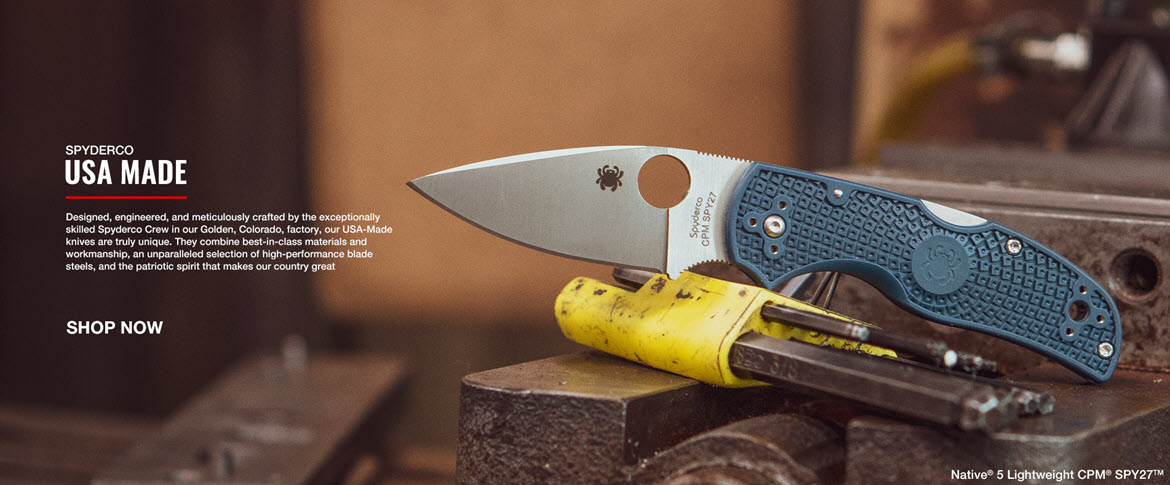
So where are Spyderco knives made? Five countries: the United States, Japan, Taiwan, Italy, and China. But the more useful answer is the one most people miss — Golden, Colorado is the only factory Spyderco owns. Everything else is built by contract partners to Spyderco’s designs under their quality control. That single distinction explains why origin lines up so neatly with steel selection, fit and finish, and price, and it’s the key to understanding where your particular knife came from and what that means.
Comparing models? Our guide to the best Spyderco knives sorts eight of them by use case, from the value-tier Tenacious to the flagship Paramilitary 2.
- Golden, Colorado, USA — Spyderco’s own factory. Flagship Compression Lock models in premium American steels.
- Seki City, Japan — the VG-10 classics, including the Delica and Endura
- Taichung, Taiwan — premium collaborations, widely regarded for the best fit and finish in the lineup
- Maniago, Italy — smaller specialty runs with European design influence
- Yangjiang, China — the value tier, including the Tenacious and the Byrd budget line
We built this from Spyderco’s published product information, retailer and industry sources including Smoky Mountain Knife Works, DLT Trading, and Country Knives, and long-running discussions among knife community members on BladeForums and Spyderco’s own forums. Manufacturing partnerships change over time, and Spyderco doesn’t publicly name every contract factory, so verify a specific model’s origin against the blade marking or Spyderco’s current catalog. You can read more about how we approach these guides.
The Distinction That Explains Everything
Spyderco is an American company headquartered in Golden, Colorado, founded by Sal and Gail Glesser and operating there since 1978. What surprises people is how much of the catalog is produced elsewhere — and the reason isn’t cost-cutting in the way you’d assume.
Golden is Spyderco’s only company-owned factory. Knife community members who’ve dug into this consistently report the same thing: the facilities in Japan, Taiwan, Italy, and China are independent contract manufacturers who build knives for Spyderco — and often for other brands too — with Spyderco responsible for the design and the quality standards rather than owning the plant.
That changes how you should read a country of origin marking. It isn’t “the good factory versus the cheap factories.” It’s Spyderco choosing a partner whose specific capabilities match a specific knife. Seki City has generations of expertise in lockbacks and Japanese steels. Taichung has a reputation for precision work in titanium and carbon fiber. Maniago is the historic center of Italian knifemaking. Each partner is doing what it’s genuinely best at.
Golden, Colorado — The Home Factory
Spyderco’s own facility sits on Spyderco Way in Golden, and it produces the models most people think of as the core catalog.
What’s made there: the flagship Compression Lock knives — the Para Military 2, the scaled-down Para 3, the Native 5, Manix 2, Military, and Shaman among them.
Steels: premium American powder metallurgy alloys including CPM-S45VN, CPM MagnaCut, and CPM SPY27 — the last of which came out of a partnership with Crucible and stays exclusive to USA production.
How to spot it: USA-made blades carry the marking “Golden, Colorado U.S.A. Earth”, which has become something of a signature.
Owning the factory also enables something Spyderco does more than most: sprint runs and dealer exclusives. Turning small limited production batches with direct quality control is far easier in a plant you control than through a contract partner.
Seki City, Japan — The Classics
Seki City is the traditional heart of Japanese cutlery, home to many knife producers — G. Sakai and Moki among the names that come up in connection with Spyderco.
What’s made there: the VG-10 classics, most notably the Delica and Endura. If you own a Spyderco with an FRN handle and a lockback, there’s a good chance it came from Seki.
Steels: historically Japanese steels, with VG-10 the signature. Community discussion over the years has noted that the Seki partnership has generally worked in Japanese-sourced steel rather than American alloys.
The Delica and Endura are arguably the knives that made Spyderco’s reputation with ordinary carriers rather than collectors — lightweight, affordable enough to actually use, and built well enough to last decades. That’s Seki’s contribution.
Taichung, Taiwan — The Precision Work
This one surprises people who assume Asian production means budget production. Taichung has the strongest fit-and-finish reputation of any Spyderco source, including Golden.
What’s made there: premium collaborations and high-end models. The Sage and Chaparral series are frequently cited, along with a range of collaboration knives with custom makers.
Materials: titanium, carbon fiber, and premium steels. Spyderco began shipping CPM-S30V to Taiwan specifically to have high-end knives produced there.
Community consensus over many years has been remarkably consistent on this point — Taichung-produced Spydercos are held in high regard, and a family-run manufacturer there handles some of the brand’s most precisely engineered work. If you’ve been avoiding a Spyderco because the blade says Taiwan, that’s a mistake worth correcting.
Maniago, Italy — The Specialty Runs
Maniago is the historic center of Italian knifemaking, and it’s home to both Fox Cutlery and LionSteel — two well-regarded manufacturers Spyderco has worked with.
What’s made there: smaller specialty runs with distinctly European design character. Models associated with Italian production over the years include the SpyOpera, Pingo, Squeak, and the LionSpy — the last being a direct collaboration reflected in the name.
Steels: premium European alloys including M390.
Italian-made Spydercos tend to be lower-volume and more design-forward than the mainstream catalog, which makes them appealing to collectors and to buyers who want something less common.
Yangjiang, China — The Value Tier
Chinese production is centered in Yangjiang, one of the world’s major knife manufacturing cities.
What’s made there: Spyderco’s value-focused models — the Tenacious and Resilience among them — along with the entire Byrd budget line.
Steels: primarily 8Cr13MoV, a budget stainless that punches above its price when heat treated well.
This is where the “who owns the factory” point matters most. The Tenacious became the benchmark budget folder that other cheap knives get compared to, and that’s not despite being made in China — it’s because Spyderco’s design and quality oversight got more from an inexpensive steel and a value-oriented production partner than competitors managed. It’s covered as our value pick in our guide to the best EDC knives for exactly that reason.
How to Check Where Your Knife Was Made
Two reliable methods.
Read the blade. Spyderco marks the country of origin on every knife. USA production carries the “Golden, Colorado U.S.A. Earth” stamp; others will indicate Japan, Taiwan, Italy, or China. If the marking has worn, a loupe and good light usually recover it.
Check the catalog. Spyderco’s own product listings identify country of origin per model, and their catalog has historically allowed sorting by it — useful if you’re shopping for a specific origin rather than identifying one you own.
If your knife has markings you don’t recognize beyond the origin, our guide to the symbols on Spyderco knives covers the rest of what’s stamped on the blade.
Does Origin Actually Matter?
Honestly: less than people think, and not in the direction they expect.
Where it matters:
- Steel selection. Certain alloys are tied to certain locations — CPM SPY27 is USA-only, VG-10 is associated with Seki, 8Cr13MoV with Chinese production. If you want a specific steel, origin narrows your options.
- Price tier. Origin correlates strongly with price, though it’s the materials and complexity driving that rather than the location itself.
- Buying American. If domestic manufacturing is a priority for you, that’s a legitimate reason to look at Golden production specifically.
Where it matters less than you’d assume:
- Quality. Taichung’s fit and finish is widely rated at or above Golden’s. Seki-made Delicas have decades of loyal owners. The consistent message from people who own knives from multiple sources is that each location does excellent work within its role.
- Longevity. A well-treated 8Cr13MoV blade from a good production partner will outlast a neglected premium blade every time. Heat treatment and care matter more than the flag on the blade.
The useful way to think about it: pick the knife, and let the origin be a consequence. Decide what size, steel, lock, and price you want, and where it’s made will sort itself out. Choosing by country first is how people end up paying more for a knife that suits them less.
Frequently Asked Questions
Where are Spyderco knives made?
Five countries: the United States, Japan, Taiwan, Italy, and China. Specifically, Golden, Colorado; Seki City, Japan; Taichung, Taiwan; Maniago, Italy; and Yangjiang, China. Golden is the only facility Spyderco owns — the others are contract manufacturing partners building to Spyderco’s designs and quality standards.
Are Spyderco knives made in the USA?
Some are. The Golden, Colorado factory produces the flagship Compression Lock models — Para Military 2, Para 3, Native 5, Manix 2, Military, and Shaman among them — in premium American steels including CPM-S45VN, MagnaCut, and SPY27. Much of the broader catalog is made by partners abroad. USA-made blades carry a “Golden, Colorado U.S.A. Earth” marking.
Which city in China does Spyderco use?
Production is centered in Yangjiang, one of the largest knife manufacturing cities in the world. Value models like the Tenacious and Resilience come from there, as does the entire Byrd budget line, generally in 8Cr13MoV steel.
Which city in Italy does Spyderco use?
Maniago, the traditional center of Italian knifemaking and home to both Fox Cutlery and LionSteel. Italian production tends toward smaller specialty runs — the SpyOpera, Pingo, Squeak, and LionSpy are associated with it, often in premium European steels like M390.
Are Taiwan-made Spydercos lower quality?
No — and the assumption gets this backward. Taichung has the strongest fit-and-finish reputation among Spyderco’s production sources, and it handles premium collaborations in titanium and carbon fiber. Spyderco ships CPM-S30V there specifically for high-end production. A Taichung-made Spyderco is generally a more expensive knife than a Golden-made one, not a cheaper one.
How do I tell where my Spyderco was made?
Read the blade — Spyderco marks the country of origin on every knife. USA production says “Golden, Colorado, U.S.A. Earth”; others indicate Japan, Taiwan, Italy, or China. Spyderco’s catalog also identifies origin by model if the marking on yours has worn.
Does Spyderco own its overseas factories?
No. Golden, Colorado is the only factory Spyderco owns. The facilities in Japan, Taiwan, Italy, and China are independent contract manufacturers producing knives to Spyderco’s designs under their quality oversight — and several of those partners make knives for other brands as well.
What is Byrd, and where is it made?
Byrd is Spyderco’s budget sub-brand, produced in China. It uses a comma-shaped opening hole rather than Spyderco’s round one, and sits at a lower price point than even the value-tier Spyderco models.
The Bottom Line
Spyderco knives come from Golden, Colorado; Seki City, Japan; Taichung, Taiwan; Maniago, Italy; and Yangjiang, China. Golden is the only one they own, and the rest are partners chosen because they’re good at something specific.
The practical takeaway isn’t to hunt for a particular flag on the blade. It’s that each source has a role — Golden for flagship Compression Lock models in premium American steel, Seki for the FRN lockback classics, Taichung for precision collaboration work, Maniago for European specialty runs, and Yangjiang for the value tier that made the brand accessible.
Pick the knife that fits your hand, your budget, and your use. The origin will follow from that, and every one of those five sources produces knives worth carrying.
Authority reference: for current model specifications and country of origin by product, see Spyderco’s official site. Manufacturing partnerships and model availability change over time — verify against the blade marking or the current catalog.
Related Reading
Note: Spyderco does not publicly identify every contract manufacturing partner by name, and manufacturing arrangements change over time. Model availability, steel selection, and country of origin for specific knives should be confirmed against the blade marking or Spyderco’s current catalog before purchase. Some information here reflects long-standing community knowledge rather than official company statements.