

A rechargeable flashlight is one of the few pieces of gear where the number on the box actively misleads you. Lumens sell lights, but many high-output flashlights hold their advertised maximum for only seconds or minutes before thermal regulation steps the output down. What actually matters is the output a light sustains, the beam shape, whether you can swap the cell at 2 a.m., and how it charges. We picked twelve lights around twelve different jobs, prioritizing models with published manufacturer specifications, credible runtime data, and enough independent information to evaluate the claims.
Short answer: For most people, the Acebeam E75 is the one to buy. It takes standard 21700 cells that are widely available, charges over USB-C, and holds 1,400 lumens for well over an hour and a half instead of collapsing after thirty seconds. If that is more light and more money than you need, the Wuben X4 at under $40 gives you a swappable battery, flood and spot, and a magnetic tail.
Quick Picks: The Best Rechargeable Flashlights
Best Overall: Acebeam E75 — Replaceable 21700, 1,400 lumens sustained, 440 meters. Around $125.
Best Value: Wuben X4 — Swappable 18650, flood plus spot, magnetic tail, under $40.
Best High-Output: Nitecore EDC31 — 3,500-lumen burst, 380 meters, dual-stage tail switch. Around $55.
Best Long-Range: Acebeam L35 2.0 — 650 meters, duty build, instant turbo. Around $119.
Best Color Accuracy: Wuben L1 (519A) — CRI above 90, rotating dual head. Around $69.
Best Multi-Function: Olight ArkPro Ultra — Flood, spot, UV and green laser in a flat body. Around $130.
Best for Work and Trades: Klein Tools 56074 — FL1-rated modes, floodlight, laser, magnetic cap. Around $56.
Best Hands-Free: Olight Oclip Pro S — Clips to a hat brim, 53 grams, white plus UV and RGB. Around $40.
Best Dual-Fuel: Klarus P2 — Rechargeable cell included, runs AA batteries in a pinch. Around $25.
Best Keychain: ThruNite Ti Mini — 650 lumens on a keyring for around $17.
Best Budget Mini: Wuben G5 — Rotating head, magnetic base, RGB. Around $20.
Best for Power Outages: Energizer Auto-On 3-Pack — Lives in the wall, turns itself on. Around $22.
What’s in this guide
- What Actually Matters in a Rechargeable Flashlight
- How We Chose
- Everyday Carry Lights
- Work and Utility Lights
- Distance and High-Output Lights
- Emergency and Backup Lights
- Comparison Table
- The Spec Most Flashlight Lists Get Wrong
- If We Were Buying Today
- Best by Budget
- Charging and Battery Ownership
- Common Buying Mistakes
- Rechargeable Flashlights FAQ
What Actually Matters in a Rechargeable Flashlight
Five things separate a light you keep from one that ends up in a drawer.
Sustained output, not maximum output. Every high-output LED generates heat faster than a small aluminum body can shed it. Manufacturers handle this with thermal regulation that steps the light down after a set interval. A light advertised at 3,500 lumens might hold that for ten seconds. The number worth comparing is what it settles at afterward and how long it stays there.
Beam shape. Lumens measure total light output; candela measures intensity in the center of the beam, and beam distance in meters comes from candela. A 1,000-lumen flood light and a 1,000-lumen thrower do completely different jobs. Flood is for close work and walking. Throw is for identifying something across a field.
Replaceable versus built-in cells. A light with a swappable 18650 or 21700 lets you carry a spare and keep working. A sealed battery means the light is dead until you find an outlet, and when the cell degrades in a few years, the light degrades with it. Built-in isn’t automatically wrong, but it’s a real limitation worth knowing about before you buy.
Charging method. USB-C on the light itself is the convenient standard. Some lights put the port on the battery instead, meaning you unscrew the tailcap to charge. Proprietary magnetic systems work well but tie you to one cable. Micro-USB in a light bought today is a sign you’re looking at older stock.
Color rendering. Most flashlights use cool white LEDs around 6500K with a color rendering index near 70. That’s fine for finding your car. It’s poor for telling red wire from brown, judging whether a fluid is oil or coolant, or seeing what a stain actually is. High-CRI lights sit around 4000-5000K with CRI above 90, and the difference is obvious the first time you use one for detail work.
Ownership Reality
The light is the cheap part. What you actually live with is the charging habit — a light you never top off is a light that’s dead when you need it, and the ones that get used are the ones with a battery indicator you can glance at.
How We Chose
We worked from manufacturer specifications and published runtime tables, independent flashlight testing from reviewers who use integrating spheres and log runtime curves, long-term owner feedback, and current retailer listings. We have not runtime-tested these lights ourselves, so every output and runtime figure here is identified as a manufacturer specification or as someone else’s measurement, never as ours. We also excluded any light whose only source of specifications was its own marketplace listing — if there’s no spec sheet and no warranty behind a product, we can’t tell you anything useful about it.
Everyday Carry Lights
ThruNite Ti Mini — Best Keychain Light

Best for: Anyone who wants real light on their keyring without thinking about it.
Six hundred and fifty lumens from something that lives on a keyring alongside your car fob is genuinely useful, and USB-C means you charge it with the cable you already own. At around $17 it costs less than a tank of gas, which matters because a keychain light’s job is to exist — the best one is the one you actually have on you.
The honest tradeoff: a light this small has almost no thermal mass, so the top output is a short burst rather than something you can run continuously. Treat the 650-lumen figure as a moment of light for identifying something, not as a work mode.
Check the ThruNite Ti Mini on Amazon →
Wuben G5 — Best Budget Mini

Best for: Glovebox, junk drawer, toolbox — a cheap light that does more than it should.
About the size of an old lighter, the G5 has a head that rotates 180 degrees and a magnetic base, which together mean you can stick it to a car hood and aim the light where you’re working. There’s a white main LED plus RGB auxiliary lighting, and the red mode is more useful than it sounds if you’re trying not to wreck your night vision.
At around $20 this is the light to buy three of and scatter around the house. The honest tradeoff: 400 lumens is modest by current standards, the clip is light-duty, and the compact body warms up quickly on high. None of that matters much at this price.
Check the Wuben G5 on Amazon →
Olight Oclip Pro S — Best Hands-Free Light

Best for: Anyone who keeps ending up holding a flashlight in their teeth.
At 53 grams the Oclip Pro S clips to a cap brim without making the hat sag, which is the entire argument for it. A magnetic base means it also sticks to metal, and the five light sources — white, UV, red, green, blue — cover more ground than the size suggests. The red mode preserves night vision and the flashing modes work as a visibility beacon if you walk or run at night.
Olight publishes the step-down plainly: 600 lumens for one minute, then 300 for fifty minutes, then 100 for another thirty. That’s honest, and it tells you exactly what this is — a close-range work light with a brief burst available.
The honest tradeoff: the battery is built in, and IPX6 means it handles spray but is not submersible.
Check the Olight Oclip Pro S on Amazon →
Olight ArkPro Ultra — Best Multi-Function

Best for: Someone who wants one flat tool in their pocket that covers four jobs.
The flat body is the point. It sits in a pocket like a phone rather than like a roll of quarters, and it carries four light sources across seven modes: a pure flood, a separate spotlight, a 365nm UV, and a Class 3R green laser. The laser can run alongside any of the other three. Charging works over USB-C or Olight’s magnetic MCC cable, and it’s rated IPX7.
Olight publishes the flood as 1,700 lumens dropping to 520 — three minutes, then a hundred and forty. That 520-lumen figure is what you actually get to use for over two hours, and it’s plenty for almost everything a pocket light does.
The honest tradeoff, and it’s a significant one: at around $130 this is the most expensive light in this guide, more than the E75 and more than the L35 2.0. You are paying for the flat format and the UV and laser, not for output or runtime. If you want light rather than features, several lights here give you more of it for less. The battery is also built in and not replaceable.
Check the Olight ArkPro Ultra on Amazon →
Work and Utility Lights
Wuben X4 — Best Value

Best for: The best capability-per-dollar in this guide.
Under $40 buys a light with a user-replaceable 3,400mAh 18650, USB-C charging, a combined flood and spot beam rated to 205 meters, a six-LED warm white side panel with stepless dimming, and a magnetic tail strong enough to hold the light on a car hood. The rectangular body doesn’t roll off a workbench, which sounds trivial until you’ve chased a round flashlight across a garage floor.
The replaceable cell is what earns it the value title rather than one of the cheaper lights. When the battery eventually degrades, you buy an 18650 rather than a new flashlight.
Independent measurement put it at roughly 1,460 lumens against Wuben’s 1,500-lumen claim, which is close enough to call the spec honest. The honest tradeoff: the main beam runs cool white with unremarkable color rendering, and brightness steps rather than dimming smoothly on the main light.
Check the Wuben X4 on Amazon →
Klein Tools 56074 — Best for Work and Trades

Best for: Electricians, technicians, inspectors, and anyone whose light needs to do three things at once.
Klein built this for the jobsite and it shows. A slim body with a dual-direction clip rides on a hat brim or a shirt pocket. There’s a floodlight in the underside for wide coverage, a Class 2 green laser for pointing at things you can’t reach, a magnetic end cap for hands-free mounting, and USB-C charging with a battery indicator. IP55 and a 6.5-foot drop rating.
What we like most about it is the honesty of the spec sheet. Klein lists three FL1-rated modes — 400 lumens for up to three hours, 200 for five, 100 for eight — and separately states that the 1,000-lumen turbo runs in 60-second intervals for quick inspections. They’re telling you outright that the headline number is a burst and the real light is 400 lumens. More manufacturers should do this.
The honest tradeoff: the battery is built in, IP55 is dust and spray resistance rather than submersion, and no wall adapter is included.
Check the Klein Tools 56074 on Amazon →
Wuben L1 (519A) — Best Color Accuracy

Best for: Automotive work, wire tracing, inspection — anywhere you need to see what something actually is.
Every other light in this guide runs cool white with ordinary color rendering. This one has a Nichia 519A flood emitter rated above CRI 90, and the difference is immediately visible on anything colored. Wire insulation, fluid leaks, paint, skin, corrosion — all of it reads correctly instead of washing out blue.
The rest of the package is strong on its own: a 180-degree rotating head with a Luminus SST-40 thrower on one face and the high-CRI flood on the other, a swappable 4,800mAh 21700 that accepts standard cells, USB-C charging, powerbank output for topping off a phone, a magnetic tail, and IP68.
Buy the right one. The L1 ships in two versions that look identical in listings. The 519A version is the high-CRI one at CRI above 90. The OSRAM P9 version is brighter on the flood but rates around CRI 70 and defeats the entire purpose. Check that the listing says 519A before you order.
The honest tradeoff, and this one is real: independent reviewers measuring the L1 found it doesn’t hold its rated output at the 30-second mark the ANSI FL1 standard specifies. One measured about 1,871 lumens at turn-on with output falling immediately and landing below spec by the time the standard says to take the reading. That’s a step beyond ordinary thermal step-down — it means the advertised number and the measured number don’t line up the way they do on the Acebeam and Klein lights here. Buy this one for the color rendering and the rotating head, which are genuinely excellent, and treat the lumen claim skeptically.
Check the Wuben L1 519A on Amazon →
Distance and High-Output Lights
Acebeam E75 — Best Overall

Best for: The person who wants to buy one flashlight and stop thinking about flashlights.
This is the configuration with four CREE XP-LR emitters in cool white 6500K: 4,000 lumens, 440 meters, 48,400 candela. Five inches long, 7.65 ounces with the battery, IP68, 1.5-meter impact rating, magnetic tail, and a single side switch running six modes.
Two things put it at the top. The first is the battery. It ships with a 5,000mAh 21700, but it accepts ordinary cells — reviewers have run flat-top unprotected 21700s and third-party button tops without issue. Nothing about this light is proprietary, so you can carry a spare, replace the cell years down the road without replacing the flashlight, and never be held hostage by one manufacturer’s battery format.
The second is the runtime table, which Acebeam publishes in full. Turbo is 4,000 lumens for one minute, then 1,400 for an hour and forty. High is 1,400 lumens for an hour forty-five. Medium is 550 for four hours forty. That 1,400-lumen sustained figure from a light this size is the number that matters, and it’s why the E75 outclasses lights with bigger headline numbers.
The honest tradeoff: 6500K cool white means unremarkable color rendering, and at around $125 it’s a real purchase. Acebeam also sells this body with Nichia 519A emitters at 5000K and CRI above 90 — 3,000 lumens instead of 4,000, and less throw, but far better color. If you do detail work more often than you look across a field, that’s the version to buy.
Check the Acebeam E75 on Amazon →
Nitecore EDC31 — Best High-Output

Best for: Maximum output and reach per dollar, in a flat body that carries easily.
At around $55 this is the most light per dollar in the guide by a wide margin. Four and a half inches, 3.53 ounces, IP68, with a dual-stage tail switch and both half and full lockout modes. A half press gives a 1,500-lumen spotlight rated to 380 meters; a full press engages Nitecore’s 3,500-lumen flood.
Both of those top modes are momentary — they run only while you hold the button, and independent testing found they drop back out in under ten seconds. Nitecore’s temperature regulation module exists specifically to pull output down as the body heats. The brightest mode you can leave running is High. Understand that going in and the EDC31 is excellent value; expect 3,500 sustained lumens and you’ll be disappointed.
The honest tradeoff: the 3,800mAh 18650 is built in and not replaceable, which is the main thing separating it from the E75 at more than twice the price.
Check the Nitecore EDC31 on Amazon →
Acebeam L35 2.0 — Best Long-Range
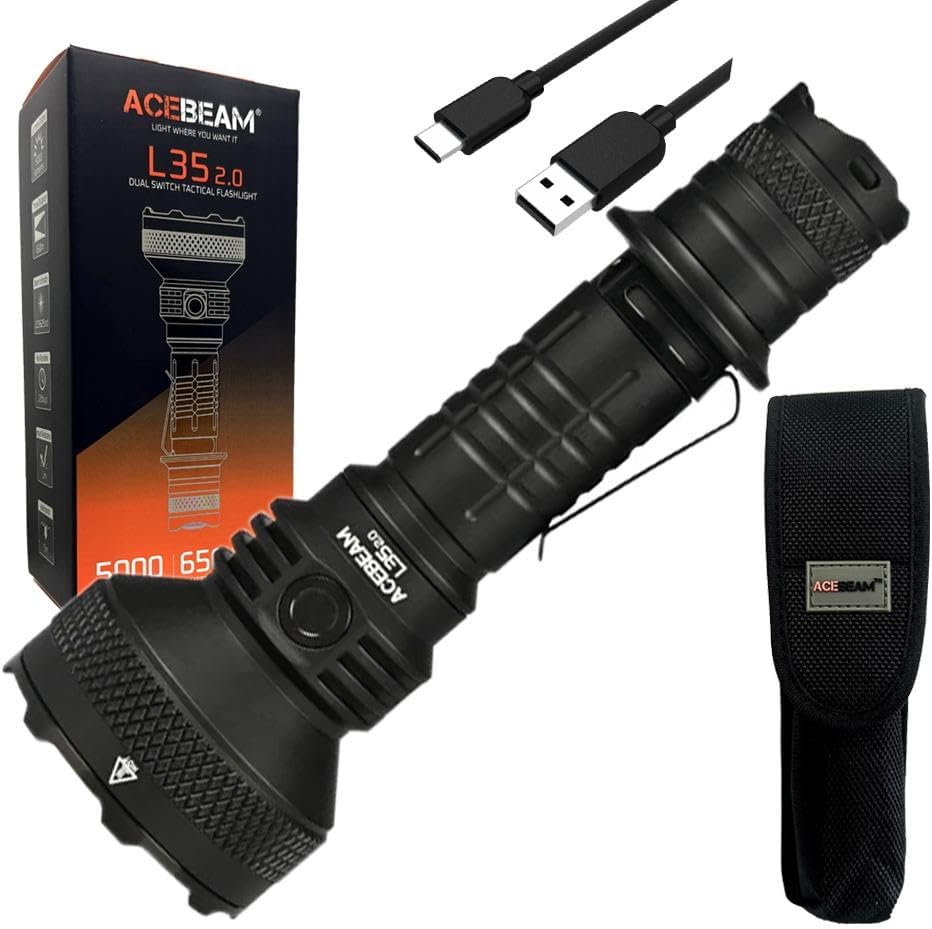
Best for: Checking the far fence line, livestock at night, search work — anywhere you need to identify something at distance.
A CREE XHP70.3 HI pushes 5,000 lumens to 650 meters at 105,625 candela. The body is one inch in diameter, IP68 to five meters, with a stainless strike bezel and a dual-switch layout — tail switch for instant turbo and strobe, side switch for everyday modes. The included 21700 has a USB-C port built into the cell.
Acebeam publishes the Turbo line as 5,000 dropping to 1,800 lumens: one minute, then an hour and fifteen. High is a flat 1,800 lumens at 370 meters for ninety minutes. That means the honest description of this light is not “5,000 lumens” — it’s a light that reliably delivers 1,800 lumens and 370 meters for an hour and a half, with a one-minute burst available when you need to reach out further.
Buy the right one. The original L35 is a different light — XHP70.2, 480 meters, 57,600 candela — and some listings for it ship with no battery at all. Confirm the title says 2.0 and lists the 650-meter throw.
The honest tradeoff: this is a duty-sized light. It doesn’t disappear in a pocket, and most people don’t need 650 meters of reach.
Check the Acebeam L35 2.0 on Amazon →
Emergency and Backup Lights
Klarus P2 — Best Dual-Fuel

Best for: The go-bag, the truck, the third day of an outage.
Most rechargeable lights have one failure mode: no power means no light, eventually. The P2 answers that by running either the included 1,800mAh USB-C rechargeable cell or two ordinary AA batteries, which you can find at any gas station in the country. A thousand lumens, 886 feet of throw on a Luminus SFT-25R, IPX8, five-foot drop rating, 3.22 ounces in a pen-sized 5.66-inch body.
For around $25 that’s a lot of capability, and the AA fallback is worth more than the spec sheet suggests during an actual emergency.
Two honest tradeoffs. The light has no charging port of its own — the USB-C port is on the battery, so the cell comes out to charge. And the tail switch has no momentary function, so a firm press turns it on and light taps cycle modes. Anyone expecting a tactical forward-clicky will notice immediately.
Check the Klarus P2 on Amazon →
Energizer Auto-On 3-Pack — Best for Power Outages

Best for: The hallway, the bedroom, the top of the basement stairs.
This solves a different problem than everything else here. It lives plugged into a wall outlet, charges itself continuously, and turns itself on automatically when the power fails. Retractable prongs let you pull it out of the socket and carry it as a handheld light. Forty lumens, about 30 meters of beam, roughly three and a half hours of runtime from a built-in AAA NiMH cell that recharges in about twelve hours.
Forty lumens sounds like nothing next to the other lights in this guide, and it is. That’s not the point. The point is that during an outage you don’t have to find anything in the dark — the light is already on, already charged, and already where you need it. Three of them for around $22 covers the paths you’d actually walk.
The honest tradeoff: it’s a locator and a navigation light, not a work light, and NiMH cells lose capacity over years of sitting on charge. Test them a couple of times a year by flipping a breaker.
Check the Energizer Auto-On 3-Pack on Amazon →
Also Worth a Look
Wuben C3

Almost every light in this guide is flat, pocket-format, or unusually shaped. Some people just want a normal cylindrical flashlight that fits the hand the way flashlights have always fit the hand. The C3 is that, at 1,200 lumens across six modes for around $25. It won’t out-spec the X4 or the EDC31, but if the shape of the others has been bothering you, this is the conventional option.
Check the Wuben C3 on Amazon →
Comparison Table
| Light | Price | Max / Sustained | Battery | Best For | Tradeoff |
|---|---|---|---|---|---|
| Acebeam E75 | ~$125 | 4,000 / 1,400 lm | Replaceable 21700 | Do-everything | Cool white, low CRI |
| Wuben X4 | ~$39 | 1,500 lm claimed | Replaceable 18650 | Value | Stepped brightness |
| Nitecore EDC31 | ~$55 | 3,500 lm burst only | Built-in 18650 | Output per dollar | Sealed battery |
| Acebeam L35 2.0 | ~$119 | 5,000 / 1,800 lm | Replaceable 21700 | 650m reach | Duty-sized |
| Wuben L1 519A | ~$69 | 2,000 lm claimed | Replaceable 21700 | CRI 90+ color | Misses rated output |
| Olight ArkPro Ultra | ~$130 | 1,700 / 520 lm | Built-in | UV + laser + flat | Priciest here |
| Klein 56074 | ~$56 | 1,000 burst / 400 lm | Built-in | Trades work | IP55, not submersible |
| Olight Oclip Pro S | ~$40 | 600 / 300 lm | Built-in | Hat-brim carry | IPX6 only |
| Klarus P2 | ~$25 | 1,000 lm | Rechargeable or 2×AA | Emergency backup | Charge port on cell |
| ThruNite Ti Mini | ~$17 | 650 lm burst | Built-in | Keyring | Tiny thermal mass |
| Wuben G5 | ~$20 | 400 lm | Built-in | Cheap utility | Light-duty clip |
| Energizer Auto-On | ~$22 | 40 lm | Built-in NiMH | Outages | Not a work light |
The Spec Most Flashlight Lists Get Wrong
Sort any retailer’s flashlight category by brightness and you’ll get listings claiming 100,000 lumens for nineteen dollars. Those numbers are fiction. But the more useful insight is that even the honest numbers don’t mean what buyers think they mean.
Here’s what four different manufacturers publish about their own lights, in their own materials:
- Klein rates the 56074 at three FL1 modes — 400, 200, and 100 lumens — and states the 1,000-lumen turbo runs in 60-second intervals.
- Olight rates the ArkPro Ultra’s flood at 1,700 lumens for three minutes, then 520 for a hundred and forty.
- Acebeam rates the L35 2.0’s turbo at 5,000 dropping to 1,800 — one minute, then an hour fifteen — and the E75’s at 4,000 dropping to 1,400.
- Nitecore makes the EDC31’s 3,500- and 1,500-lumen modes momentary-only, available while you hold the button.
Four companies, four spec sheets, the same story. The maximum output is a burst. The sustained output is the light.
This isn’t manufacturers being dishonest — it’s physics. A small aluminum tube can only shed so much heat, and running an LED at full power past that point damages the emitter and the cell. Thermal regulation is the light protecting itself. The companies worth trusting are the ones that publish the step-down instead of hiding it.
So the practical version: compare the second number, not the first. The E75’s 1,400 sustained lumens beats the EDC31’s 3,500-lumen burst for any task lasting longer than ten seconds. A light that holds 500 lumens for two hours is more useful for real work than one that hits 2,000 for forty seconds and then drops to 200.
And when a listing gives you a huge lumen number with no runtime table at all, that absence is the answer.
If We Were Buying Today
If we wanted one light and no further thought → Acebeam E75
If we were spending as little as possible without buying junk → Wuben X4
If we wanted the most output per dollar → Nitecore EDC31
If we needed to see across a field → Acebeam L35 2.0
If we work on cars or wiring → Wuben L1 519A
If the light needs to survive an outage with no power for days → Klarus P2
If we just want a light on our keys → ThruNite Ti Mini
Best by Budget
Under $25. The ThruNite Ti Mini at around $17, the Wuben G5 at around $20, the Energizer 3-pack at around $22, and the Klarus P2 at around $25. At this level you’re buying a specific solution to a specific problem — a keyring light, a glovebox light, outage coverage, an emergency backup. That’s a good way to spend $25.
$25 to $70. The heart of the range. The Wuben X4 at around $39 and the Nitecore EDC31 at around $55 are the two best all-around buys in this guide. The Klein 56074 at around $56 and the Wuben L1 at around $69 buy specialization — jobsite features and color accuracy respectively. Most people should buy in this band.
Over $100. The L35 2.0 at around $119, the E75 at around $125, the ArkPro Ultra at around $130. What the extra money buys is not simply more lumens. It’s a bigger replaceable cell, enough thermal mass to hold high output for an hour instead of a minute, better waterproofing, and better regulation. Whether that’s worth double the price depends entirely on whether you use a flashlight for twenty seconds a week or two hours a night.
Prices are approximate and move constantly. Check current pricing before you buy.
Charging and Battery Ownership
Lithium-ion cells don’t like extremes. Storing a light fully charged or fully empty for months shortens cell life. If a light is going into a drawer for a season, leave it around half charged and top it off a couple of times a year.
Heat is the enemy. A flashlight left on a dashboard through a summer will lose capacity faster than one that lives indoors. This is worth knowing if you keep a light in the truck.
Know where the port is. Most lights here charge through a port on the body. The Klarus P2 charges through a port on the battery itself, which means unscrewing the tailcap. Neither approach is wrong, but discovering it at midnight is annoying.
Replaceable cells extend the life of the whole light. The E75, L35 2.0, X4, and L1 all take standard 18650 or 21700 cells. When the battery degrades in a few years, you buy a battery. On sealed-battery lights — the EDC31, ArkPro Ultra, Klein, and Oclip Pro S — battery degradation is much harder to solve because the user can’t simply swap in a fresh standard cell.
Buy cells from reputable sources. Counterfeit 18650s and 21700s with wildly overstated capacity are common. If a 5,000mAh 21700 costs four dollars, it isn’t one.
Common Buying Mistakes
- Sorting by lumens. The number is a burst on nearly every light. Compare sustained output and runtime instead.
- Believing five-digit lumen claims. No handheld light produces 100,000 lumens. These listings are fabrications and the products behind them have no spec sheets or warranties.
- Buying a thrower for indoor work. A tight, intense beam is miserable in a crawlspace. Match the beam to the distance you actually work at.
- Ignoring the battery format. A proprietary or sealed cell means you can’t swap in a fresh standard battery when the original degrades.
- Buying the wrong variant. Several lights here ship in multiple emitter configurations under the same name with different outputs and color rendering. Check the model designation, not just the product name.
- Buying micro-USB in a light purchased today. Some older stock is still circulating. USB-C should be the baseline.
- Buying one light for every job. A keyring light and a 650-meter thrower solve different problems. Two cheap purpose-built lights often beat one expensive compromise.
Rechargeable Flashlights FAQ
How long do rechargeable flashlight batteries last?
Quality lithium-ion cells typically handle several hundred charge cycles before capacity drops noticeably. For most owners that translates to several years. Lights with replaceable cells can be refreshed for the cost of a battery; lights with sealed cells generally can’t.
Are rechargeable flashlights better than battery-powered ones?
For regular use, generally yes — no recurring battery cost, more consistent output, and higher available power. For a light that sits untouched in a go-bag for two years, disposable lithium primaries hold their charge longer. That’s why dual-fuel lights that accept either exist.
What is a good number of lumens for a flashlight?
For household and walking use, 200 to 500 lumens is plenty. For work and outdoor use, 800 to 1,500 sustained is a comfortable range. Anything beyond that is either a burst mode or a specialized long-range tool. Sustained output matters more than the maximum.
What does high CRI mean and do I need it?
CRI measures how accurately a light source renders color compared to daylight. Most flashlights sit near CRI 70; high-CRI lights are CRI 90 or above. If you trace wiring, work on vehicles, inspect surfaces, or need to identify what something is rather than just where it is, it’s a genuine upgrade. For walking the dog, it isn’t necessary.
Why does my flashlight get dimmer after a minute?
That’s thermal regulation, and it’s the light protecting itself. Running an LED at maximum output generates more heat than a small body can shed, so the driver steps output down to a level it can sustain. Nearly every high-output light does this, and the better manufacturers publish exactly when and how far.
Can I use any 18650 or 21700 battery in these lights?
It depends on the light. The Acebeam E75 accepts standard cells including flat-top unprotected ones. Some lights need protected button-top cells, and a few use proprietary batteries entirely. Check the manual before buying spares — a cell that’s slightly too short can cause the light to cut out under impact.
What’s the best rechargeable flashlight for power outages?
A plug-in unit that turns itself on, like the Energizer Auto-On, solves the first problem: finding a light in the dark. Pair it with a dual-fuel light such as the Klarus P2 that runs AA batteries when the outage stretches past a few days and there’s nowhere to charge.
The Bottom Line
For most people, buy the Acebeam E75. Standard replaceable 21700, USB-C, and 1,400 lumens held for over an hour and a half. It’s the light you buy once.
If that’s more than you want to spend, the Wuben X4 at under $40 keeps the thing that matters most — a swappable cell — and adds a magnetic tail and a genuinely useful side panel.
If you want maximum output and reach for the money and can live with a sealed battery, the Nitecore EDC31 is one of the strongest performance-per-dollar buys in the guide at around $55.
If you work on anything where color matters, the Wuben L1 in the 519A version will change how you see the job, even though its lumen claim doesn’t hold up.
And whatever you buy, spend three dollars on the Energizer plug-ins per outlet. The best flashlight in the world doesn’t help if you can’t find it when the lights go out.
Continue Your Research
Output and runtime figures follow the ANSI/PLATO FL-1 standard, which defines how lumens, beam distance, and runtime are measured.
Sources: Manufacturer specifications and published runtime tables from Acebeam, Nitecore, Olight, Wuben, Klein Tools, Klarus, ThruNite, and Energizer; independent flashlight testing; current retailer listings.
Affiliate disclosure: Guns Ammo & Gear participates in affiliate programs and may earn a commission on purchases made through links on this page, at no additional cost to you. Affiliate relationships never determine which products we recommend or how we describe them.
Note: Prices are approximate and change frequently. Verify current pricing and specifications before purchasing.
Thanks so much, Mark. That means a lot, and it's exactly why we write these. The 43X and 48 share…
Love hearing this, William. That's the best kind of ownership story: a gun that frustrated you at first and ended…
This one of the best gun reviews I have seen! Very informative and well said. It has helped me on…
You bet ! I absolutely love this gun now that I figured how to compensate for the wiggle! I have…
Thanks, JD, that's a fair point, and we appreciate you taking the time to share it. The 22 suppressor market…


